25 Days of Cloud: A Countdown of Lessons That Actually Matter
•
AWSCloud EngineeringDevOpsReliabilitySecurityInfrastructure
Real lessons from the cloud—failure, scaling, security, and reliability. A countdown of practical wisdom for engineers studying AWS certifications or building production systems.
I originally shared these as a daily "25 Days of Cloud" series across X and LinkedIn while building CertForge in public.
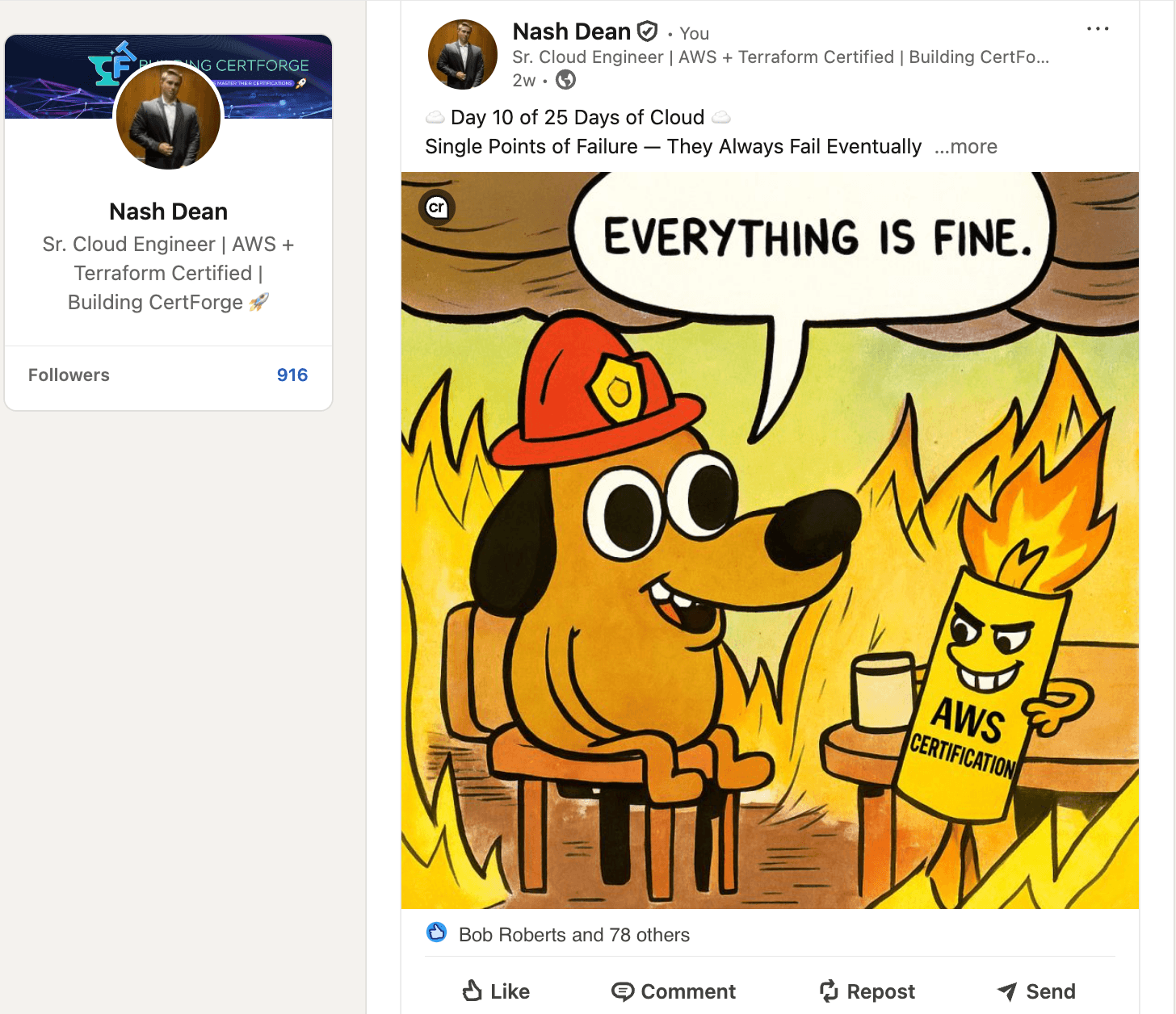 LinkedIn Post Screenshot
What started as a consistency challenge turned into something better: real conversations about what actually breaks in cloud systems—and what experienced engineers learn to do differently.
This article is the durable version: a countdown you can reference, whether you're studying for AWS certs, scaling an app, or trying to build good engineering judgment.
The themes repeat for a reason:
- failure isn't rare—it's normal
- scaling is mostly about protecting your dependencies
- security is usually a configuration problem
- reliability is a mindset, not a service
Let's count it down.
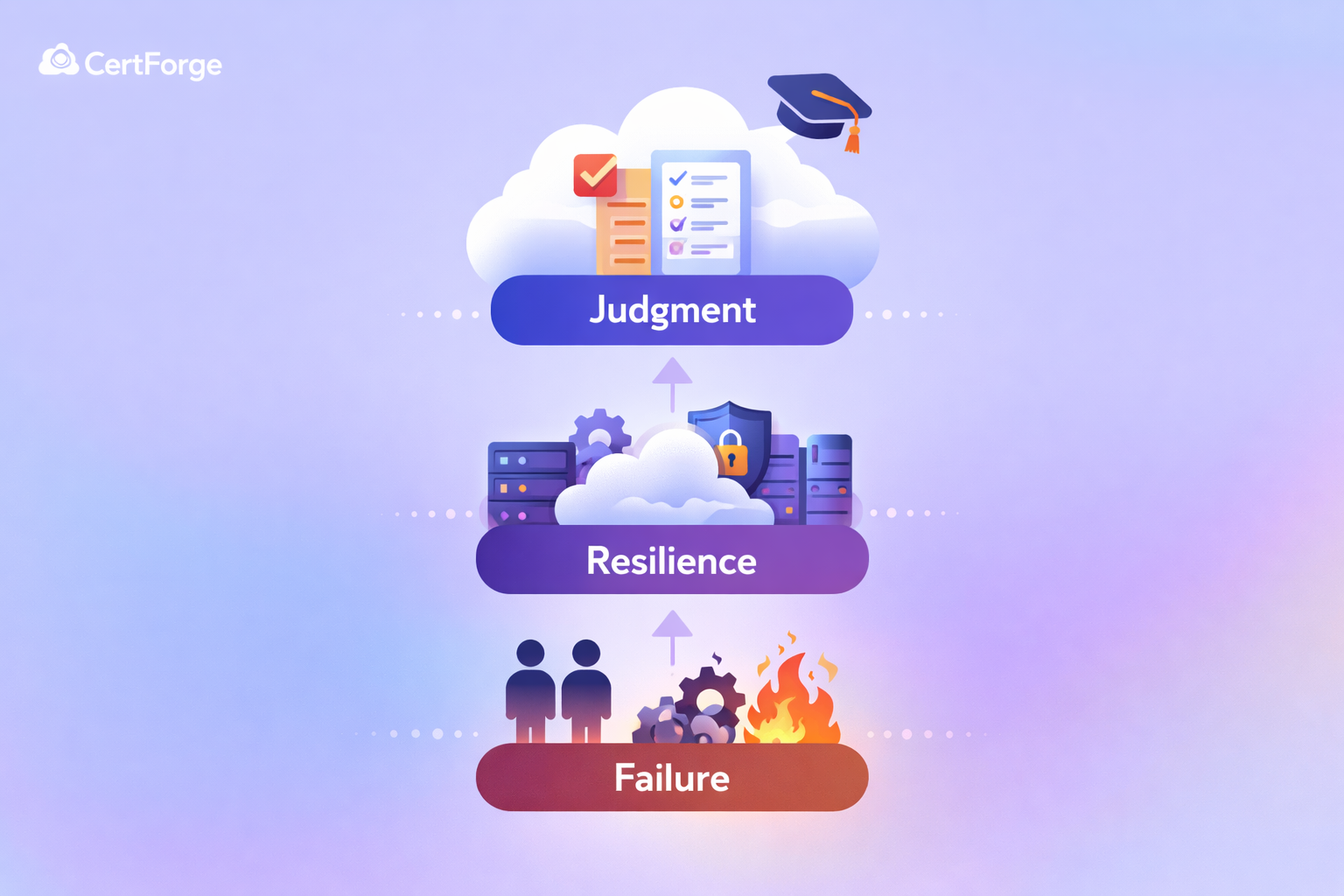
Day 25 — Cloud Is About People (Christmas Edition)
The best lesson from the series wasn't technical.
Good engineering is about people:
- the people who use the system
- the people who maintain it
- the people who are on-call when things break
Cloud is just a tool.
What matters is what you build—and how responsibly you build it.
What matters is what you build—and how responsibly you build it.
CertForge exists because certifications should help you build judgment, not just memorization.
If you followed the series or joined the discussions: thank you. That consistency was worth it.
If you followed the series or joined the discussions: thank you. That consistency was worth it.
Day 24 — Most Outages Aren't Bugs. They're Deployments.
If deploying your app makes you nervous, your CI/CD pipeline is the problem.
Deployments are where otherwise "stable" systems fall apart because:
- releases are too large
- rollback is missing or untested
- environments drift
- "it worked in staging" becomes the plan
Healthy deploys are boring:
- repeatable
- reversible
- small blast radius
- observable
If you can deploy multiple times a day without fear, you've built a real capability.
Day 23 — API Gateway Is Your First Line of Defense
APIs are where your system meets the world, and API Gateway is where you decide how much chaos you'll allow inside.
API Gateway is not just routing. It's:
- authentication & authorization
- throttling & quotas
- request validation
- versioning
- blast-radius control
The simplest rule:
bad traffic should die at the edge, not inside your services.
bad traffic should die at the edge, not inside your services.
Day 22 — Authentication ≠ Authorization
Authentication answers: who are you?
Authorization answers: what can you do?
Authorization answers: what can you do?
Most systems get this wrong by accident:
- "they're logged in, so it's fine"
- permissions become scattered, inconsistent, and fragile
- "temporary" admin access becomes permanent
Two principles that scale well:
- default deny
- centralized authorization logic (roles/scopes/policies with clear boundaries)
Day 21 — Secrets Management: Security Fails Quietly
Most security incidents begin with leaked secrets, not sophisticated attacks.
Common failure modes:
- keys in repos
- tokens in logs
- credentials baked into containers
- long-lived access that no one rotates
A durable secrets posture looks like:
- a real secrets manager (not "just env vars")
- least privilege for secret access
- rotation as a habit
- audit trails you can trust
- recovery plans assuming secrets will leak
Security doesn't usually fail loudly. It fails quietly—until it's public.
Day 20 — Infrastructure as Code: Consistency Is the Superpower
Console-clicking is fast… until it becomes untraceable.
IaC gives you:
- reproducibility
- review and change history
- rollback
- fewer "mystery differences" between environments
Drift is inevitable. Detection is mandatory.
If infrastructure can't be recreated from code, it isn't reliable—it's an artifact of human memory.
Day 19 — Circuit Breakers & Graceful Degradation
Dependencies fail. Cascades are optional.
Circuit breakers prevent "one bad dependency" from taking down everything:
- stop calling unhealthy services
- fail fast
- recover deliberately
Graceful degradation keeps the system usable:
- cached data
- read-only mode
- disabling non-critical features
- reduced functionality that preserves availability
Users don't expect perfection. They expect the system to stay up.
Day 18 — Rate Limiting & Backpressure Protect You From Success
A healthy system can still die from traffic.
Causes:
- retries amplifying load
- bots scraping endpoints
- a sudden spike from success (or a viral link)
- misbehaving clients
Edge protection matters:
- rate limits at the gateway
- quotas per user/tenant
- backpressure to protect downstream dependencies
- fail-fast responses (429s) over timeouts and thread exhaustion
Rate limiting isn't saying "no."
It's making sure you can keep saying "yes."
It's making sure you can keep saying "yes."
Day 17 — Idempotency: The Boring Concept That Saves You
Retries are guaranteed in distributed systems.
Without idempotency:
- duplicate writes happen
- emails get sent twice
- users get billed twice
- state becomes corrupted
With idempotency:
- retries become harmless
- "at least once" delivery becomes predictable
The simplest move: idempotency keys for operations with side effects.
If you build async systems, idempotency isn't optional—it's a requirement.
Day 16 — Observability: If You Can't See It, You Can't Scale It
As systems grow, failures don't announce themselves.
You need all three:
- logs (what happened)
- metrics (how often / how bad)
- traces (where latency and failures originate)
Dashboards should answer questions:
- What's broken?
- Is this getting worse?
- Is it isolated or widespread?
And alerts should be actionable. Signal beats noise.
Scaling without observability is flying blind. Eventually the lights go out—and you won't know why.
Day 15 — Async Processing: Scale Without Blocking Users
If users have to wait, your system doesn't scale.
Async processing removes heavy work from the request path:
- emails and notifications
- report generation
- webhooks
- AI tasks
- batch processing
Queues smooth spikes (SQS/EventBridge/Kafka/etc.) and protect your downstream services.
Important reality check:
- async ≠ fire-and-forget
- retries will happen
- you need DLQs, visibility timeouts, monitoring, and idempotency
Async systems feel complex at first—then they become the only sustainable way to grow.
Day 14 — Caching vs Databases: Your First Line of Defense
Databases become your most expensive and fragile dependency as you scale.
One of the best scaling moves is simple:
stop hitting the database for everything.
Cache candidates:
- read-heavy queries
- metadata and configuration
- reference data
- computed results with predictable TTLs
Caching improves:
- latency
- cost
- reliability (fewer DB connections, smaller blast radius)
And yes, cache invalidation is still hard.
Use sane TTLs, write-through patterns, and event-driven invalidation when needed.
Treat databases like scarce resources. Caches help you scale responsibly.
Day 13 — Database Scaling Is About Connections
Most "slow database" problems are actually connection overload problems.
Common realities:
- too many open connections crush performance
- connection pooling is mandatory (RDS Proxy / PgBouncer / app pooling)
- serverless can cause connection storms
- reads scale horizontally; writes don't
This is one of the easiest places to blow up a beta launch—because everything looks fine until concurrency hits.
Day 12 — Cost Optimization Is the New Reliability
Cloud budgets aren't blank checks anymore.
Cost optimization is now an engineering skill:
- right-size resources
- set autoscaling limits intentionally
- tag and allocate costs by environment/workload
- eliminate idle resources (NAT gateways, load balancers, orphaned volumes/snapshots)
- choose architectures that don't "leak" money
Efficient systems don't just save dollars—they reduce operational risk.
Day 11 — re:Invent Theme: AI Is Now Core Cloud Infrastructure
AI isn't an add-on anymore. It's becoming foundational to cloud:
- agentic workflows
- AI-assisted ops
- custom silicon for AI workloads
- smarter automation in the platform itself
Translation for engineers:
learning cloud increasingly means learning how AI fits into infrastructure, workflows, and operations—not just compute/network/storage.
Day 10 — Single Points of Failure Always Fail (A Real Story)
This lesson showed up in the most ridiculous way: trying to take my AWS Developer exam.
- At home: the network check failed.
- At the testing center: the entire school district network was down.
- Both "redundant" testing centers failed because they shared the same upstream dependency.
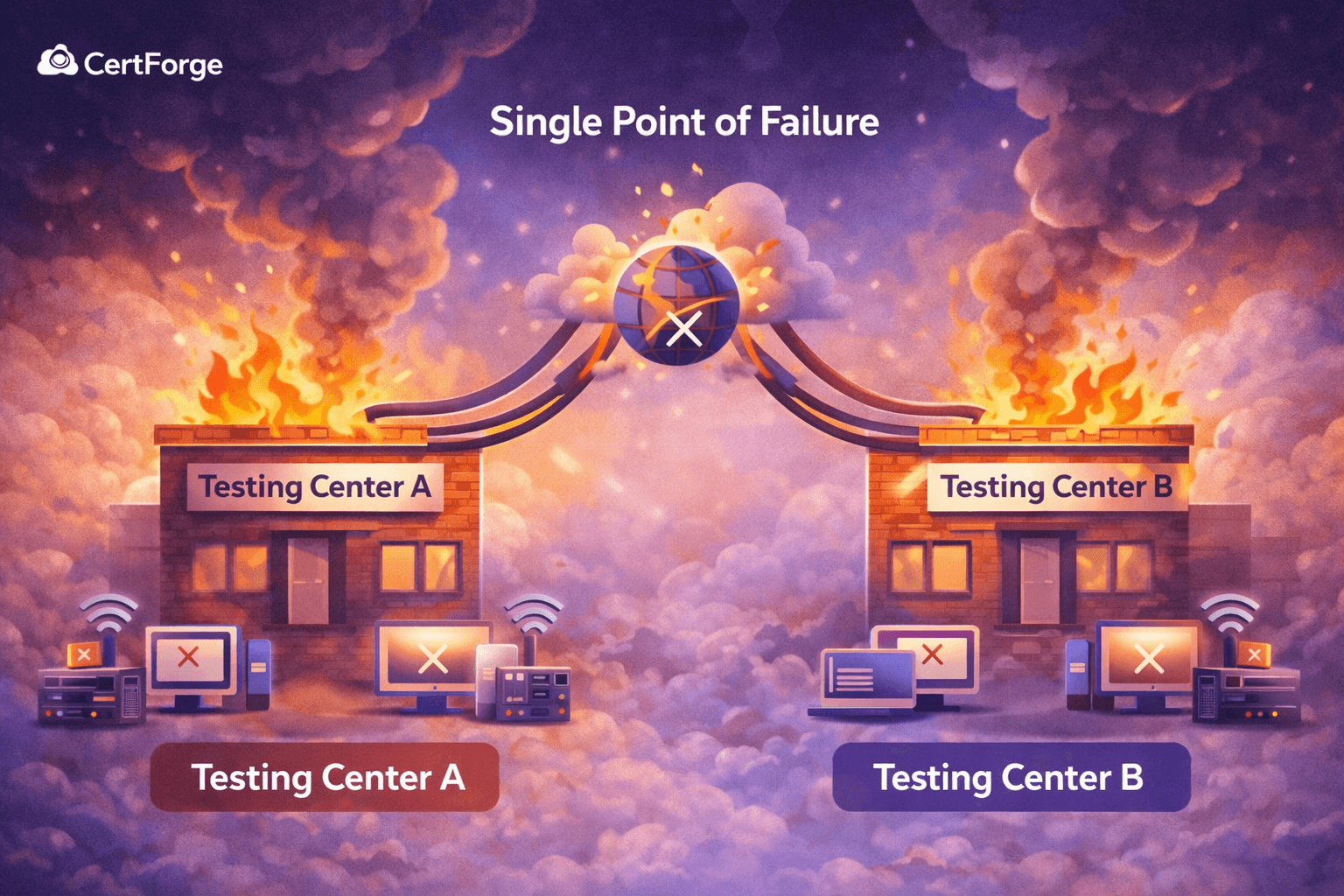 Single Point of Failure - Testing Centers
That's the core lesson:
redundancy isn't real if it shares the same failure domain.
Two systems can look independent and still fail together.
Day 9 — Network Reliability: The Part Everyone Forgets
Cloud engineering isn't just servers and code—it's everything from the data center to the last mile.
Local networking issues masquerade as "cloud problems":
- DNS hiccups
- packet loss
- ISP routing issues
And redundancy matters at every layer:
- Wi-Fi vs ethernet
- VPN configuration
- resolvers
- multi-path routing
If people can't reliably connect, the backend doesn't matter.
Day 8 — AWS Shared Responsibility Model
AWS is responsible for the cloud.
You are responsible in the cloud.
You are responsible in the cloud.
AWS secures:
- physical data centers
- hardware and infrastructure
- managed service foundations
You secure:
- IAM
- data protection
- configuration
- app vulnerabilities
- incident response
Misconfiguration is your outage. Compliance isn't the same as secure.
Day 7 — Durable Lambda Functions & Long-Running Workflows
Long-running, multi-step workflows have historically forced engineers into custom orchestration and state management.
Newer patterns push toward:
- checkpointing
- pause/resume
- retry from last safe step
The broader point:
serverless is evolving from "single function calls" into safer, more durable workflow primitives.
Day 6 — Reduce Your Blast Radius (Cloudflare Outage Reminder)
When major providers hiccup, it's a reminder: dependencies matter.
Reduce your blast radius by:
- avoiding single-vendor critical paths
- designing multi-region failovers where it matters
- building graceful degradation paths (serve cached data, drop non-critical features)
Resilience isn't built during outages. It's built before them.
Day 5 — S3 Durability ≠ Backup
S3 is durable, but durability doesn't protect you from:
- deletion
- overwrites
- misconfiguration
- compromised credentials
Versioning and lifecycle controls make S3 safe in practice, not just on paper.
Day 4 — VPC Design Is the Foundation
Network design determines:
- security posture
- latency
- cost
- scalability
Practical rules:
- plan CIDRs early
- keep non-public services private
- use VPC endpoints to avoid public routing and reduce cost
Bad network design follows you forever.
Day 3 — Terraform State Is Sacred
Terraform works when the state is trusted.
Rules that save careers:
- don't edit state manually
- use remote backends with locking
- protect state with versioning and encryption
- make small plans frequently
- modularize to reduce complexity and blast radius
State is Terraform's source of truth. Treat it like production data.
Day 2 — IAM: Least Privilege Isn't Optional
IAM is the real security boundary.
Practical habits:
- start with deny and grant only what's required
- prefer roles over users
- scope permissions intentionally
- audit and rotate regularly
IAM is invisible when done right—and painful when it's wrong.
Day 1 — Design for Failure
In the cloud, everything fails eventually:
instances die, AZs fail, deployments break, credentials expire.
Three practical reminders:
- multi-AZ for critical workloads
- stateless services scale and recover faster
- fail fast + observe everything
Reliability is a competitive advantage.
Closing Thought
The point of cloud learning isn't to memorize services.
It's to build the judgment to design systems that survive real traffic, real failures, and real humans using them.
It's to build the judgment to design systems that survive real traffic, real failures, and real humans using them.
If you're building, studying, or scaling: I hope this countdown helps.
And if you're learning for certifications: CertForge is being built to make that learning practical, not abstract.