AWS SAA-C03 Study Plan: 4-Week and 8-Week Schedules That Follow the Exam Guide
•
AWSAWS CertificationSolutions Architect AssociateSAA-C03Study PlanExam Prep
A practical AWS Solutions Architect Associate (SAA-C03) study plan with 4-week and 8-week schedules mapped to the four exam domains, plus how to use practice tests, labs, and your score report.
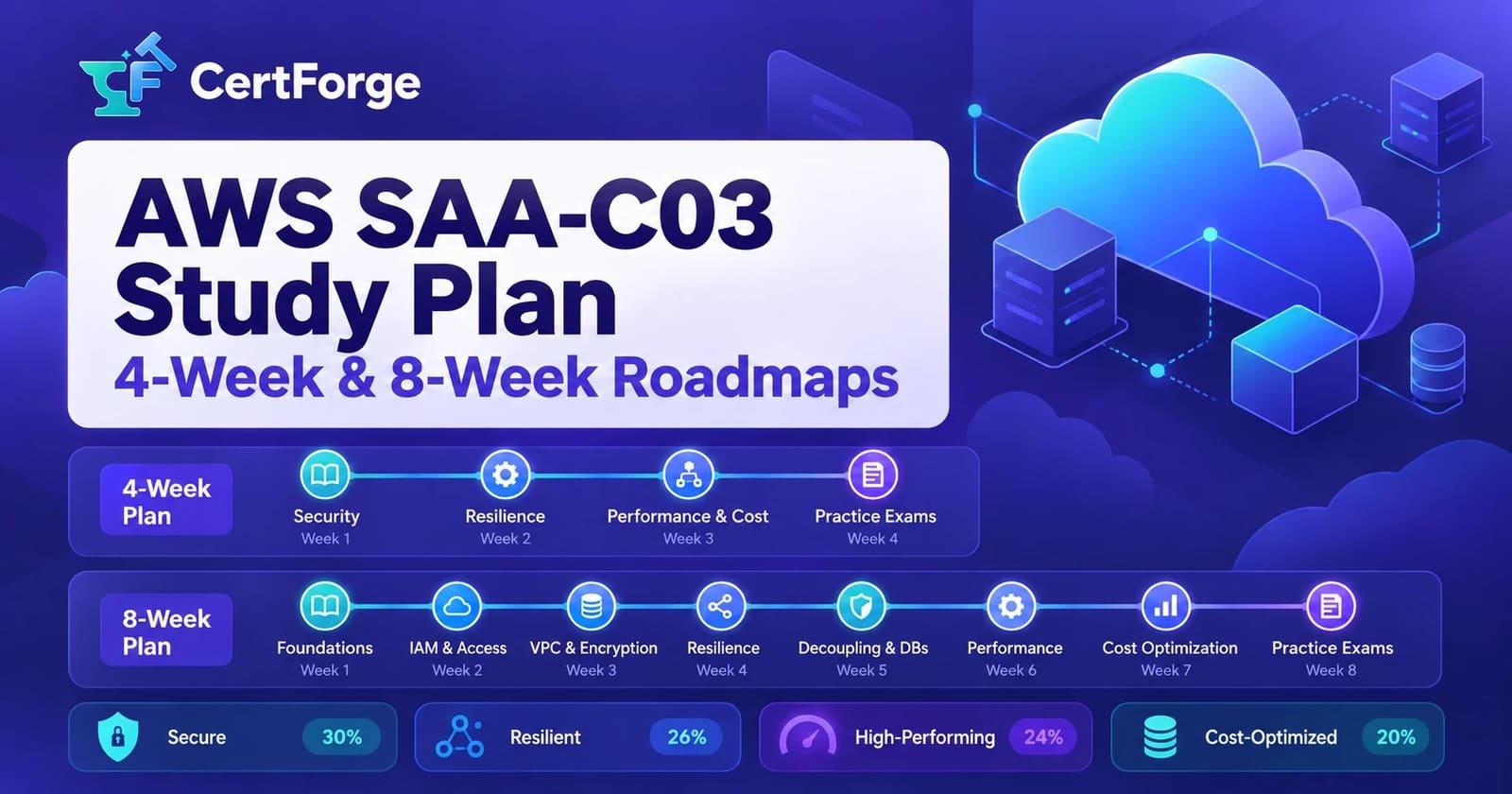
"How should I study for the SAA?" is one of the most common questions in AWS certification communities.
Most of the answers are a list of resources: a course, a practice test bank, maybe the official exam guide. What's usually missing is the plan: what to study each week, how long to spend on each part, and how to tell when you're ready.
This guide gives you two schedules for the AWS Certified Solutions Architect – Associate (SAA-C03) exam:
- a 4-week plan if you already work with AWS or have passed Cloud Practitioner recently
- an 8-week plan if you're newer to AWS or studying around a full-time job
Both are built on the same idea: spend your time in proportion to what the exam actually weighs.
💡
Exam details change. Before you start, check the official SAA-C03 exam guide on the AWS Certification site for the current domains, weightings, price, and policies.
What the SAA-C03 Exam Looks Like
| Detail | SAA-C03 |
|---|---|
| Questions | 65 (50 scored, 15 unscored) |
| Time | 130 minutes |
| Format | Multiple choice and multiple response |
| Passing score | 720 out of 1000 (scaled) |
| Price | 150 USD |
The exam is split into four domains:
| Domain | Weight | What it really tests |
|---|---|---|
| 1. Design Secure Architectures | 30% | IAM, least privilege, encryption, VPC security, protecting data |
| 2. Design Resilient Architectures | 26% | Multi-AZ, decoupling, backups, disaster recovery, scaling |
| 3. Design High-Performing Architectures | 24% | Picking the right compute, storage, database, and caching |
| 4. Design Cost-Optimized Architectures | 20% | Pricing models, storage tiers, right-sizing, data transfer costs |
Security alone is almost a third of the exam. If your study time is mostly EC2 and S3 trivia, your time is out of proportion to the score.
💡
Key Insight: SAA-C03 is a decision exam, not a definitions exam. Most questions describe a scenario and ask for the best option given a constraint such as "most cost-effective", "least operational overhead" or "highest availability". Study the trade-offs, not just the services.
Before You Start: Take a Baseline Practice Set
Don't start week 1 blind. Before you study anything, take a 20 to 30 question practice set that covers all four domains. It takes about 40 to 60 minutes, and it gives you enough questions per domain to see a real pattern.
Don't expect a passing score. Most people score well below a passing level before they start studying, and that's fine. This set is a measurement, not a test of you. You're trying to find out:
- which domains already feel familiar
- which services you've never heard of
- whether scenario questions slow you down
Write down your score for each domain. Your weakest domain is the one you'll come back to every week.
Check Again Halfway Through
Take a second practice set about halfway through your plan: at the end of week 2 on the 4-week plan, or week 4 on the 8-week plan. Use the same size as your baseline (20 to 30 questions across all four domains) but different questions, so the comparison is fair.
Compare your domain scores with the baseline:
- domains that went up are working, so keep going
- domains that barely moved need a different approach, such as more labs or a different explanation
- a domain you thought was fine but dropped needs another review
This gives you two data points before the final week. When you take your last practice exams, you'll know whether you're really improving or just getting used to the questions.
✅
Baseline → midpoint → final. Three measurements tell you much more than one. The jump from your baseline to your final week is also the best sign that you're ready.
The 4-Week SAA-C03 Study Plan
Best for: people who use AWS at work, or who passed Cloud Practitioner in the last few months.
Time: about 10 to 12 hours a week.
Week 1: Secure Architectures (30%)
- IAM users, groups, roles, policies, and how policy evaluation works
- IAM roles for EC2 and Lambda, cross-account access, and AWS Organizations with SCPs
- VPC basics: subnets, route tables, internet and NAT gateways, security groups vs network ACLs
- Encryption with KMS, S3 bucket policies, and blocking public access
- Lab: build a VPC with public and private subnets, and put an EC2 instance in the private subnet that reaches the internet through a NAT gateway
- Practice: 30 to 40 questions on security only
Week 2: Resilient Architectures (26%)
- Multi-AZ vs multi-Region, and ELB with Auto Scaling groups
- Decoupling with SQS, SNS, and EventBridge
- RDS Multi-AZ vs read replicas, Aurora, and DynamoDB global tables
- Backups and DR strategies: backup and restore, pilot light, warm standby, multi-site
- Route 53 routing policies and health checks
- Lab: put an Auto Scaling group behind an Application Load Balancer, terminate an instance, and watch it get replaced
- Practice: 30 to 40 questions on resilience, plus 10 from week 1
- Checkpoint: take your midpoint practice set at the end of the week and compare it with your baseline
Week 3: High-Performing and Cost-Optimized Architectures (44%)
- Compute choices: EC2 instance families, Lambda, ECS and Fargate
- Storage choices: EBS volume types, EFS, FSx, and S3 storage classes
- Caching with CloudFront and ElastiCache, and DynamoDB DAX
- Data and analytics services you need to recognize: Kinesis, Athena, Glue, Redshift
- Pricing: On-Demand, Savings Plans, Reserved Instances, Spot
- S3 lifecycle policies, Intelligent-Tiering, and data transfer costs
- Practice: 40 to 50 mixed questions
Week 4: Full Practice Exams and Weak-Area Review
- Take two or three full-length timed practice exams (65 questions, 130 minutes)
- Compare each domain score with your baseline and midpoint results
- After each one, review every question, including the ones you got right by guessing
- Spend most of the week on the domain with your lowest score
- Two or three days before the exam, stop taking full exams and switch to light review
The 8-Week SAA-C03 Study Plan
Best for: people newer to AWS, career changers, or anyone studying around a full-time job.
Time: about 6 to 8 hours a week.
| Week | Focus | Hands-on |
|---|---|---|
| 1 | Baseline practice set of 20 to 30 questions (no expectation of passing), then AWS foundations: Regions and AZs, IAM basics, EC2, S3, the shared responsibility model | Launch an EC2 instance, host a static site on S3 |
| 2 | Security, part 1: IAM policies and roles, Organizations, SCPs | Write a least-privilege policy and test it |
| 3 | Security, part 2: VPC design, security groups vs NACLs, KMS, Secrets Manager | Build a two-tier VPC |
| 4 | Resilience: ELB, Auto Scaling, Multi-AZ, Route 53, then a midpoint practice set to compare with your baseline | ALB with Auto Scaling, then break it on purpose |
| 5 | Decoupling and databases: SQS, SNS, EventBridge, RDS, Aurora, DynamoDB | Small serverless API with Lambda and DynamoDB |
| 6 | Performance: storage types, caching, CloudFront, containers, analytics services | Put CloudFront in front of your S3 site |
| 7 | Cost optimization, plus a full practice exam | Set up AWS Budgets and Cost Explorer |
| 8 | Two more full practice exams, weak-area review, then rest | — |
From week 3 onwards, end every week with 20 to 30 practice questions that mix the current topic with earlier weeks. Mixing topics is what makes it stick.
⚠️
Labs cost money if you forget them. Before your first lab, create an AWS Budgets alert at a few dollars. When each lab is done, delete NAT gateways, load balancers, RDS instances and Elastic IPs, since those are the usual surprise charges.
How to Use Practice Tests Without Memorizing Them
Practice tests are the most useful study tool for SAA-C03, and the easiest one to misuse.
- Don't retake the same test until you score 90%. By then you're testing your memory, not your understanding.
- Review the wrong options too. For each question, you should be able to say why every other answer is worse in this scenario.
- Track scores by domain, not just overall. An overall 75% can hide a 55% in security.
- Use fresh questions as you get close. New questions are the only honest readiness check.
A good rule of thumb: if you score 80% or higher on fresh, timed practice exams, in every domain, you're usually ready.
Signs You're Ready to Book (or Keep) Your Exam Date
You're probably ready when:
- you can explain why one option beats another, not just which one is right
- your weakest domain is close to your average, not far below it
- you finish full practice exams with at least 10 minutes to spare
- keyword clues like "least operational overhead" or "decouple" point you straight to an answer
If you're not there a week before your exam, rescheduling is usually cheaper than a retake.
If You Don't Pass the First Time
A lot of people miss SAA-C03 by a small margin. A score in the mid-600s means you're close.
- Your score report breaks your performance down by domain. Use it to decide what to study.
- AWS currently requires a 14-day wait before a retake, and a retake costs the full exam price. Check the current retake policy before you book.
- Don't start the whole plan over. Spend two to three weeks on your weakest one or two domains, then take fresh practice exams.
Final Thoughts
There's no secret resource for SAA-C03. The people who pass on their first attempt usually do three things well:
- they spend their time in proportion to the domain weights
- they build a few real things in AWS, so the scenarios make sense
- they use practice questions to find gaps, not to memorize answers
Pick the 4-week or the 8-week plan, put the weeks in your calendar, and take your baseline practice set today, without worrying about the score.
When you're a day out, read our guide on what to do the day before your AWS certification exam. If you want more hands-on practice, see Top 5 Beginner-Friendly AWS Projects.
Practice SAA-C03 With CertForge
CertForge is built around the official exam guide. Every question is mapped to an SAA-C03 domain, your progress is tracked per domain, and each round gives you new questions, so you train understanding instead of memorizing a question bank.
Free and paid plans
Start practicing for free
Practice SAA-C03 by domain, find your weak spots, and see when you're actually ready.
Create a free account
 Create a free account
Built for exam readiness, not passive review.